
DO Cava
Denominació d'Origen Cava

Visit DO Cava Wineries: A Unique Experience
Now you can visit DO Cava wineries with us and enjoy wine tourism while discovering how cava is made.
You’ll visit the most iconic wineries of this Designation of Origin while enjoying unique experiences among vineyards and nature, always with a glass of cava in hand.
On each visit, you’ll discover the best-kept secrets of this sparkling wine, made using the traditional method and with a unique character shaped by its climate and native grape varieties.
You can discover the Designation of Origin by visiting its vineyards and wineries, and see how tradition continues to carefully nurture the grapes before they are transformed into a high-quality sparkling wine.
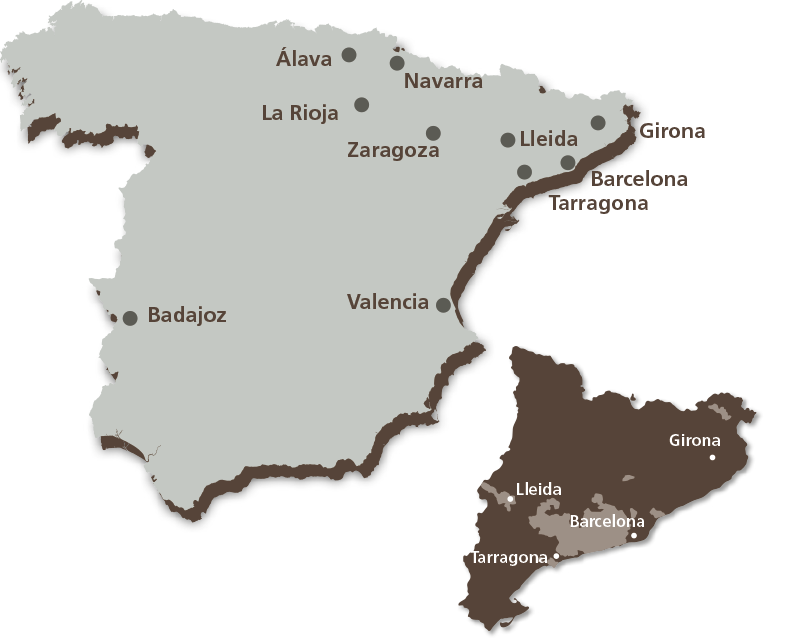
Most cava wineries are not far from Barcelona and can be reached in less than an hour by car. Local wine tourism, right on your doorstep.
Coming?
Dades de la DO Cava
- Total Area: 37,924 ha
- Bottling Wineries: 214
- Average Production (75 cl): 244,472,340 bottles
White Grape Varieties
- Xarel·lo
- Chardonnay
- Macabeu
- Subirat Parent
-
Parellada
Xarel·lo
Red Grape Varieties
- Monastrell
- Garnatxa Negra
- Trepat
- Pinot Noir

Looking for inspiration? Explore our recommendations.

Want to discover the best places and experiences to explore the DO Cava region?
We’ll show you our favourite places so you can discover them with a glass of cava in hand.
Experiences in Penedès
It is one of the leading wine tourism regions in Spain. Located between the provinces of Barcelona and Tarragona, it stretches between the sea and the mountains. Towns and cities such as Vilafranca del Penedès, Sant Sadurní d’Anoia, Sitges, and El Vendrell are part of this region.
Castle Route. The ancient Marca Hispanica, established by Charlemagne around the year 795, was a defensive territory where castles were built throughout this borderland. You can visit the castles of Olèrdola, Castellví de la Marca, Gelida, and Subirats.
Cava and Champagne: Do You Know the Differences?
While it is true that Cava was originally inspired by Champagne, it is also true that today Cava has a unique and distinctive character of its own.
Cava-producing regions enjoy a different climate from the French wine-producing regions and, in addition, different grape varieties are used, such as Macabeu, Xarel·lo, and Parellada.
Today, Cava enjoys an excellent reputation worldwide and is one of the most widely consumed sparkling wines in the world.
What Is the Origin of Champagne?
Without going into too much detail, we can say that Champagne originated from an attempt to solve a problem: when wine was stored in a glass bottle, the bottle would eventually explode due to the carbon dioxide produced during fermentation.
It was in the 17th century when a Benedictine monk, while searching for ways to eliminate the troublesome bubbles produced during fermentation, accidentally tasted the sparkling wine and decided it was better to leave it that way, with its characteristic bubbles. It was 1693, and at the Abbey of Hautvillers, the monk Dom Pérignon had just created the first Champagne.
This sparkling wine soon became popular among French royalty and spread throughout the rest of Europe.
And What Is the Origin of Cava?
The first Spanish sparkling wine was bottled by a winemaker from Reus in 1862 and became known as “Xampany de Reus” (Reus Champagne). A decade later, Josep Raventós of Codorníu helped firmly establish the history of Cava.
Josep Raventós had worked in the Champagne region and brought back the méthode champenoise and the sparkling wine production methods involving double fermentation: first in barrels and then in bottles.
At the family estate in Sant Sadurní d’Anoia, known as Can Codorníu, Josep began producing sparkling wine using native grape varieties. In 1872, the first sparkling wine was released onto the market.
From then on, the history of Cava became a success story, as many wineries became interested in producing sparkling wine.
In 1986, when Spain joined the European Union, the name Champagne was replaced by Cava, as Champagne was a protected designation. The Cava name had already been officially introduced in 1972.
The Traditional Method or 'Méthode Champenoise'
The Cava production method has certain distinctive characteristics that set it apart from other sparkling wines.
All Cavas are produced using the Traditional Method, also known as the Méthode Champenoise, whose main characteristic is that a second fermentation takes place in the bottle.
The 10 Steps to Making Cava:
- Harvesting. This mainly takes place in August. Grapes are usually harvested early in order to preserve higher acidity.
- Pressing. The grapes are gently pressed. Different grape varieties are never mixed at this stage.
- First fermentation. The must undergoes its first fermentation, producing the base wine.
- Blending. Each winery creates its own blend depending on the type of Cava it wants to produce.
- Tirage. The wine resulting from the first fermentation is bottled, and a mixture of sugar and yeast is added to trigger a second fermentation.
- Second fermentation. The bottles are placed horizontally, stacked in rows, for a minimum of 9 months. The carbon dioxide produced during fermentation becomes integrated into the wine.
- Riddling. The bottles are placed at an angle in riddling racks and slowly rotated so that the sediment moves down towards the neck.
- Disgorging. The neck of the bottle is frozen so that when the temporary stopper is removed, the sediment is expelled as well.
- Dosage. The liquid lost during disgorging is replaced by adding wine and sugar.
- Corking and labelling. The final cork, metal cap, wire cage, capsule, and labels are added.
We use cookies to optimize our website and our service.